
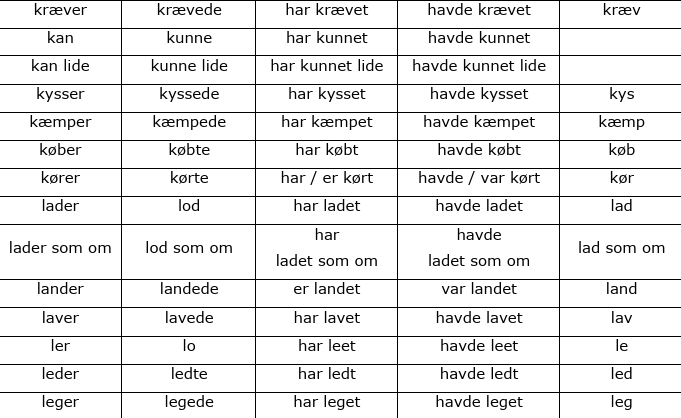
Verbs are the words that we use to express actions, processes and states, like jeg spiser ‘I’m eating’, det regner ‘it’s raining’, vi venter ‘we’re waiting’. When learning the language, it may be useful for you to know, that verbs in Danish can be grouped according to their past tense form as in these examples below.
Three groups
- Dans-ede (danced), Spill-ede (played), Bo-ede (lived)
- Spis-te (ate), Ros-te (praised), Vend-te (turned)
- Snyder -> snød (cheats -> cheated), Går -> gik (walks -> walked), Har -> Havde (has -> had), Gør -> gjorde (does -> did), Er/var (is -> was).
Groups 1. and 2. are the regular verbs and account for the great majority of verbs in the dictionary, while group 3. is irregular verbs of various kinds and shapes – these form a smaller group but are used more frequently than the rest. So, irregular verbs make up a smaller group but are used more often in the language.
A fuller account would sub-divide group 3. into sub-groups that have changes in common, like:
- Skyder/skød, Snyder/snød, Nyder/nød, Gyder/gød,
- Driver/drev, Skriver/skrev, Griber/greb
- Drikker/drak, Giver/gav, Vinder/vandt
There are also cases of optionality, where you can use either group 1. and 2. and it would still be correct, and also language change in the making, where younger speakers will have a regular form (group 1. or 2.) while older speakers will have an irregular form. Notice also, that some of the group 3. verbs take a “-t” ending, like “Vandt” ‘won’.